

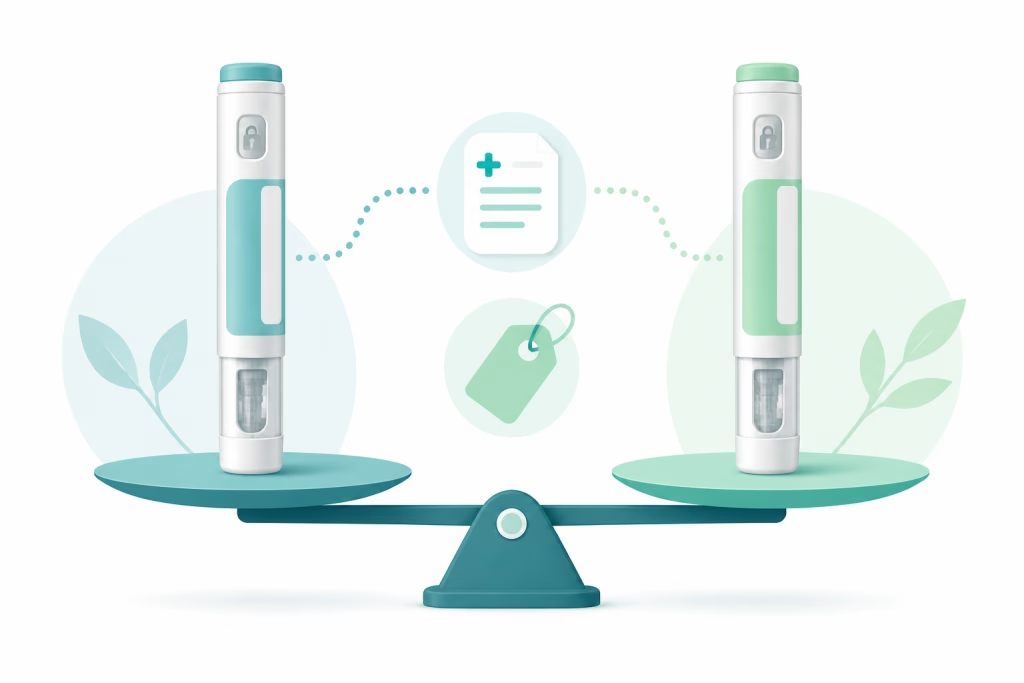
Mounjaro vs Zepbound is one of the most common questions people ask once they realize the two pens look nearly identical, and the short answer is that they are the same medication. Both are tirzepatide, made by Eli Lilly, in the same six strengths, with the same weekly schedule. What separates them is the FDA label, which decides who can be prescribed each one, whether insurance pays, and how much you spend if it does not. This guide lays out the differences that matter and how to track either one.
Mounjaro vs Zepbound: what is actually the same
Start with the overlap, because it is almost everything:
- Same active ingredient. Both are tirzepatide, a dual GIP and GLP-1 receptor agonist, and both are brand-name only with no generic version.
- Same doses. 2.5 mg, 5 mg, 7.5 mg, 10 mg, 12.5 mg and 15 mg, injected once a week.
- Same titration. Four weeks at 2.5 mg, then 5 mg, with increases of 2.5 mg no sooner than every four weeks up to a maximum of 15 mg if you need it.
- Same side effects. Nausea, constipation, diarrhea, indigestion and reduced appetite are the common ones, usually strongest around dose increases. The warnings about thyroid C-cell tumors, pancreatitis and gallbladder problems appear on both labels.
- Same injection sites. Stomach, thigh or the back of the upper arm, rotating each week.
In other words, a 5 mg dose of Mounjaro and a 5 mg dose of Zepbound do the same thing in your body. If you are more interested in how tirzepatide compares with semaglutide, our Zepbound vs Wegovy comparison covers that head-to-head, and the Ozempic vs Wegovy guide explains the semaglutide version of this exact same-drug, different-label situation.
The real difference: what each label is approved for
The FDA approved Mounjaro in May 2022 to improve blood sugar in people with type 2 diabetes, alongside diet and exercise, and that approval now covers adults and, more recently, children 10 and older. Weight loss happens on Mounjaro, but it is not what the label says the drug is for.
Zepbound arrived in November 2023 as the weight-management version. It is approved for chronic weight management in adults with obesity, or who are overweight with at least one weight-related condition, and in late 2024 it also became the first medication approved for moderate to severe obstructive sleep apnea in adults with obesity.
That Mounjaro vs Zepbound label difference has three practical consequences:
- Prescribing. A prescriber can write Mounjaro for weight loss off-label, and some do, but pharmacies and insurers see the diagnosis code, not the intent.
- Coverage. Insurers decide what to pay for based on the approved use, which is why the same molecule can be covered under one name and denied under the other.
- Support programs. Lilly’s savings cards are brand-specific. The Mounjaro card requires a type 2 diabetes diagnosis; the Zepbound card does not.
Mounjaro vs Zepbound cost and insurance in 2026
This is where the two names stop being twins. List prices are close, roughly $1,080 to $1,110 a month for Mounjaro and up to about $1,086 for Zepbound before any discount, according to SingleCare’s comparison. Almost nobody pays that, but the path to a lower price depends on which label you are on.
With commercial insurance
Most plans cover Mounjaro for type 2 diabetes, often with prior authorization, and the Mounjaro Savings Card can bring a commercially insured copay down to as little as $25 a month if your prescription carries a diabetes diagnosis. Zepbound coverage for weight loss is less consistent and changes often: some employer plans dropped it, while CVS Caremark brought Zepbound back on October 1, 2026. When it is covered, the Zepbound Savings Card also works out to about $25 a month for eligible commercial plans. If your plan says no, our guide on appealing a Wegovy or Zepbound denial walks through what evidence tends to win.
Paying cash
Self-pay is where Zepbound is the better deal, because Lilly built its discount program around the weight-management brand. Through LillyDirect, Zepbound vials and the multi-dose KwikPen cost $299 a month for 2.5 mg, $399 for 5 mg, and $449 for 7.5 mg through 15 mg as long as you refill within 45 days. Mounjaro’s self-pay listing on TrumpRx starts at $499 a month for the single-dose pens. Our TrumpRx price breakdown compares these numbers with Wegovy and Ozempic, and the free GLP-1 cost calculator will project your first-year total as you move up the doses.
Medicare
Medicare Part D generally covers Mounjaro for type 2 diabetes. Zepbound is usually not covered for weight loss alone, though the sleep apnea approval opened a door for some beneficiaries, and the new Medicare GLP-1 Bridge program sets a $50 copay for Zepbound for people who qualify. Our Medicare GLP-1 coverage guide has the details.
Pens, vials and the KwikPen
Devices are the other place Mounjaro vs Zepbound diverges. Mounjaro in the United States comes as a single-dose auto-injector pen with the needle built in, four pens to a month. Zepbound comes three ways: the same style of single-dose pen, single-dose vials you draw up with a syringe, and the newer multi-dose KwikPen that holds four weekly doses in one device. The vials and KwikPen are only sold through Lilly’s self-pay channel, which is one more reason cash buyers end up on Zepbound. If you are new to the pen, our Zepbound KwikPen guide covers needles, priming and counting the doses left.
Can you switch between Mounjaro and Zepbound?
Because the medicine is identical, switching is a paperwork question rather than a medical one. People usually move for one of three reasons: an insurer stops covering one brand, a diagnosis changes, or they go from insured to self-pay and want LillyDirect pricing. Your prescriber writes a new prescription for the same strength you are already on, and you take the next dose on your usual day. There is no need to restart at 2.5 mg, and no washout period, since you are not changing drugs.
A few things do deserve attention during a switch:
- Timing. Keep the weekly gap. If the new prescription is delayed, the missed GLP-1 dose rules for tirzepatide apply: take it within four days or skip it.
- Device. Going from a single-dose pen to a vial or KwikPen changes the routine, so read the Instructions for Use before the first dose.
- Price windows. LillyDirect’s $449 tier depends on refilling within 45 days, so note each order date.
Logging the last dose under one brand and the first under the other keeps the timeline clean, and you can do that free with Pep, which tracks tirzepatide by strength and injection site regardless of the name on the box.
How to choose when you have a choice
Most people never get to decide Mounjaro vs Zepbound for themselves; the diagnosis and the insurance plan pick for them. If you have type 2 diabetes and commercial insurance, Mounjaro with the savings card is almost always the cheaper route. If you are using tirzepatide for weight or sleep apnea, Zepbound is the on-label option, and it is also the one with the lowest cash prices. The medication is the same either way, so the decision comes down to the label your plan will pay for and the device you prefer.
Mounjaro vs Zepbound FAQ
Is Mounjaro stronger than Zepbound?
No. Both contain the same tirzepatide in the same six strengths. A 10 mg dose of either brand delivers the same amount of medication.
Why is Zepbound cheaper than Mounjaro without insurance?
Lilly offers its lowest self-pay prices through LillyDirect for Zepbound vials and KwikPens, from $299 to $449 a month. Mounjaro’s self-pay listing starts at $499 for single-dose pens, and it does not come in vials or a multi-dose pen in the US.
Can my doctor prescribe Mounjaro for weight loss?
Prescribers can write Mounjaro off-label, but insurers generally cover it only with a type 2 diabetes diagnosis, and the Mounjaro Savings Card requires one. For weight management, Zepbound is the on-label prescription.
Download Pep free — track your shots, pills & progress in one app.


This article is educational only and is not medical or financial advice. Talk with your prescriber and pharmacist about which prescription is right for you. Prices were checked on LillyDirect, TrumpRx.gov and SingleCare in October 2026 and can change.