

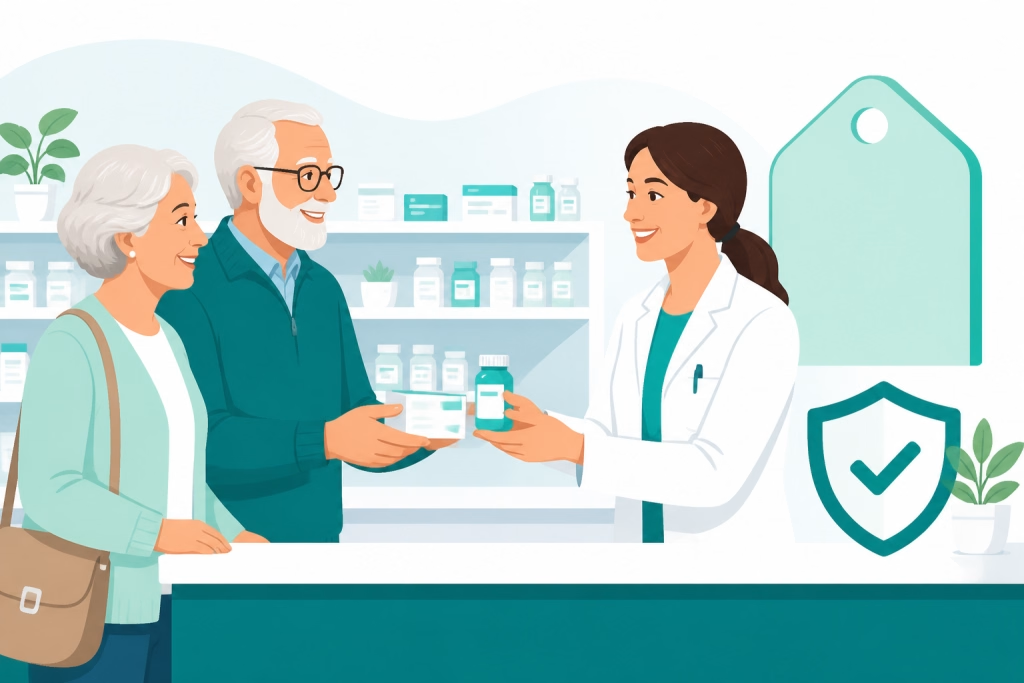
Medicare GLP-1 coverage in 2026 finally includes weight management, and the headline number is simple: $50 a month. As of July 1, 2026, a temporary federal program called the Medicare GLP-1 Bridge lets eligible people with Medicare drug coverage (Part D) get Wegovy, the Wegovy pill, Foundayo, or the Zepbound KwikPen for a flat $50 copay. That is a big change, because for two decades Medicare was barred by law from paying for medications used specifically for weight loss.
This guide walks through who qualifies, exactly what the $50 covers (and what it doesn’t), how to get started, and the fine print that surprises people. Everything below comes from the official Medicare.gov and CMS program pages, not from a pharmacy flyer.
What Medicare GLP-1 coverage in 2026 actually is
The Medicare GLP-1 Bridge is a short-term demonstration run by the Centers for Medicare & Medicaid Services (CMS). It runs from July 1, 2026 through December 31, 2027. It was originally scheduled to end in December 2026, but CMS extended it by a year after a larger successor program (the BALANCE Model) was delayed on the Medicare side.
Here is the part that trips people up: the Bridge sits outside your regular Part D plan. Your plan doesn’t opt in, doesn’t process the claim, and doesn’t bear the cost. Instead, CMS pays pharmacies through a single central processor, and you pay $50 at the counter. That structure explains most of the quirks covered later in this article.
Which medications are covered
- Wegovy (semaglutide) — both the weekly injection and the once-daily Wegovy pill
- Foundayo (orforglipron) — the once-daily GLP-1 pill approved in April 2026
- Zepbound (tirzepatide) — KwikPen only. Single-dose Zepbound pens and Zepbound vials are not covered.
Ozempic and Mounjaro are not part of the Bridge. They are the diabetes-labeled versions of the same molecules, and Part D plans already cover them for type 2 diabetes. If you are weighing the pills against each other, our Wegovy pill vs Foundayo comparison covers dosing, results, and the 30-minute fasting rule.
Who qualifies for Medicare GLP-1 coverage in 2026
First, you need Medicare drug coverage. That includes a standalone Part D plan, a Medicare Advantage plan with drug coverage, a Special Needs Plan, or an employer/union group waiver plan. Original Medicare (Parts A and B) alone is not enough.
Second, you must be 18 or older and fall into one of three BMI tiers at the time you started GLP-1 therapy:
- BMI 35 or higher — no other condition required.
- BMI 30 or higher plus at least one of: diastolic heart failure (heart failure with preserved ejection fraction), uncontrolled high blood pressure, or chronic kidney disease stage 3a or higher.
- BMI 27 or higher plus at least one of: prediabetes, a previous heart attack or stroke, or symptomatic peripheral artery disease.
The “when you started therapy” wording matters. If you began Wegovy a year ago at a BMI of 36 and have since dropped to 31, your prescriber can attest to your starting BMI and you can still qualify. Medicare is not asking you to regain weight to prove you need the medication.
Who is not eligible
- People who already get a GLP-1 covered through their Part D plan (for example, Ozempic for type 2 diabetes). You keep using your plan; the Bridge is not for you.
- People with type 2 diabetes, moderate-to-severe sleep apnea, or fatty liver disease (MASH). Those are Medicare-covered uses, so your Part D plan may cover a GLP-1 through the normal benefit instead. Ask your provider.
- Anyone without Part D or Medicare Advantage drug coverage.
How to get started: prescription plus prior authorization
There is no enrollment form for you to fill out. The process runs through your prescriber and pharmacy:
- Talk to your doctor. They confirm you meet one of the BMI tiers and send a prescription for a covered drug to your pharmacy.
- Prior authorization. When the pharmacy requests it, your provider submits a short prior authorization to the central processor (electronically through CoverMyMeds or by fax). They must certify you are using the medication alongside a lifestyle program focused on diet and exercise. Decisions come back within about 72 hours.
- Approval letter. You get a letter in the mail confirming your drug is covered under the Bridge. Your prior authorization then stays valid, including refills and dose changes, through December 31, 2027, unless you switch to a different GLP-1.
- Pick up and pay $50. The pharmacy may ask for your Medicare Number or the last four digits of your Social Security Number to process the claim.
If anything stalls, 1-800-MEDICARE (1-800-633-4227) can check the status of your prior authorization.
New to these medications? Our tips for new GLP-1 users cover the first few weeks, and the free GLP-1 dose schedule calculator will map out your titration dates from your first dose.
The $50 copay: what it includes and what it doesn’t
The copay is a flat $50 for each one-month supply (28 or 30 days, depending on the drug), regardless of your dose or your income. It does not rise as you step up from a starter dose to a maintenance dose, which is unusual and helpful. Behind the scenes, Novo Nordisk and Eli Lilly agreed to a net price of $245 per month for these drugs under the program, so Medicare picks up the difference.
Because the Bridge operates outside your Part D plan, though, the $50 behaves differently from a normal copay:
- It does not count toward your Part D deductible or the $2,100 out-of-pocket cap for 2026 ($2,400 in 2027).
- It won’t appear on your Part D Explanation of Benefits or a Medicare Summary Notice.
- Extra Help (the low-income subsidy) cannot lower it. Everyone pays $50.
- It cannot be spread out using the Medicare Prescription Payment Plan.
- Your copay stays $50 no matter which Part D benefit phase you are in.
For most people, $50 is far below the manufacturer self-pay programs ($149 to $499 a month, depending on the drug and dose). Our GLP-1 cost guide lays out those cash prices, our TrumpRx Wegovy price guide lists every self-pay dose tier (and explains why Medicare members can’t use them), and the free GLP-1 cost calculator lets you compare your options side by side.
What happens after 2027
Nobody knows yet. The Bridge was designed as a stopgap until the BALANCE Model brought GLP-1 coverage into Part D plans themselves. CMS delayed the Medicare portion of BALANCE indefinitely in April 2026 after too few Part D plans signed up, and extended the Bridge through 2027 instead. Unless CMS extends it again or Congress changes the law that excludes weight-loss drugs from Part D, Bridge coverage could end on December 31, 2027.
That is worth planning for. If you are already on a GLP-1, keep good records: your starting weight and BMI, your dose history, and how your health markers have moved. If a new coverage pathway opens in 2028 with its own paperwork, that history is what your provider will need. You can track it free with Pep, which logs each shot or pill, weight, and side effects in one place. If you’re on the daily pill, our Wegovy pill tracker guide covers what to log each morning, including refill dates and cost.
Practical tips for Medicare GLP-1 users
- Ask about the KwikPen specifically if you are prescribed Zepbound. A prescription written for single-dose pens or vials will be rejected.
- Don’t switch drugs casually. Your prior authorization is tied to one GLP-1. Changing from Wegovy to Foundayo means a new prior authorization.
- Check your Part D status during Open Enrollment. The Bridge requires you to keep Medicare drug coverage. Dropping your plan drops your Bridge eligibility too. Our Medicare open enrollment GLP-1 guide explains why you do not need to switch plans for 2027 and what to check before December 7.
- Save your approval letter. It is your proof of coverage if a pharmacy’s system has trouble processing the claim.
- Compare before you decide. If you are choosing between medications, Zepbound vs Wegovy breaks down the results and side effects.
For the official rules and an eligibility quiz, see the Medicare.gov weight loss drugs page.
Medicare GLP-1 coverage 2026: FAQ
Does Medicare cover Ozempic for weight loss in 2026?
No. The Medicare GLP-1 Bridge covers Wegovy (injection and pill), Foundayo, and the Zepbound KwikPen for weight management. Ozempic and Mounjaro are covered by Part D plans only for approved uses like type 2 diabetes.
Is the $50 Medicare GLP-1 copay the same at every dose?
Yes. The copay is $50 per one-month supply at every dose step, for every income level. Extra Help and the Medicare Prescription Payment Plan do not apply to it.
How long does Medicare GLP-1 coverage under the Bridge last?
The program runs from July 1, 2026 through December 31, 2027. An approved prior authorization stays valid through the end of 2027 unless you change medications. What happens in 2028 depends on future CMS or Congressional action.
Download Pep free — track your shots, pills & progress in one app.

This article is for educational purposes only and is not medical, legal, or insurance advice. Program rules can change; confirm details with Medicare.gov, your plan, and your healthcare provider.